Friday, February 22, 2013

Government Island Champion Passes

c
Several days ago, a good friend of Government Island, Rex Scouten, passed away.  Rex had a long and distinguished career as a secret service agent in the Truman administration.  Later he was Chief Usher of the White House and finished his career as White House Curator.  He served ten presidents.  In 1992, when Jane Conner discovered that Government Island would be divided into housing lots, she went Mr. Scouten at the White House to ask for assistance.  He said he would do everything possible to help preserve the historical isle.  After several visits to the island, he had the Stafford Board of Supervisors and County Administrator for lunch at the White House.  In 1998, the supervisors purchased the isle.  Rex headed the Government Island Committee which determined how to make the island a low impact park to share with the nation.  Rex and his wife returned to Stafford to participate in the opening of Government Island Park in 2010.  He spoke at Aquia Church for the park’s dedication and was pleased that Stafford saw fit to preserve this nationally significant historic site.
This is a picture of Rex going out to the island years ago before the current bridges were built.  Sometimes he even had to go over by balancing on a log.

Saturday, January 26, 2013


Working on Island Begins
Last month it was mentioned that the planner of Washington D.C, Pierre L’Enfant, purchased the island for the U.S. Government.  After he bought the isle, he traveled to Philadelphia.  In the winter he wrote his assistant, Issac Roberdeau, and ordered that he:  “….repair immediately to Acquia [sic] Creek to see the qurries [sic] there belonging to the public – to have barracks erected thereon for twenty men on each of these quarries, on the island purchased from Mr. George Brent and on that rented from Mr. John Gibson of Dumphries (Today we still don’t know where Mr. Gibson’s quarry was located.  Evidently it was on Aquia Creek and very close to the island, as a canal was dug connecting the two facilities)  ….The exporting of stone must be begun at once on both quarries; they must be opened at once all around the island…”  Can you imagine how busy it must have been on the island? 

L’Enfant never returned to the island, because The Commissioners in D.C. told him that he was no longer needed. He became a lonely, poor man.  He was described as, “Daily through the city stalks the picture of famine, L’’Enfant and his dog…”   Today 200 years later, L’Enfant’s name graces streets, squares, and buildings paying homage to this creative city planner.  However, L’Enfant went to his grave never receiving recognition or adequate pay for his accomplishments.         J. Conner, historian

Tuesday, January 1, 2013

First Day Hike

Happy New Year!  Did you get out for a First Day Hike?  If not, you have 364 more chances to get outside and experience a bit of nature.  The rain did not materialize, so off we went for a short walk at Government Island.  Crossing over the bridge at the beginning of the walk, I couldn't help but notice all the trash that has built up.  Will have to get something done about that.  It is a perfect time for a park clean-up.  The plants are dormant, and the snakes and frogs are resting during the cold weather.  You may have noticed that the grasses look all trodden down.  True, some of it is caused by the wildlife, most likely the deer.  However, some grasses remain upright when they dry and others naturally lie down flat.  When summer brings a new crop of grasses, that topic will be the subject of a future entry.


With this entry I would like to point out some of the vines that are easy to spot when the forest is bare of foliage.  The most obvious vine is poison ivy , a member of the cashew family.  It grows abundantly along the path, mostly in the first section.  All parts of poison ivy can cause allergic reactions to the majority of humans.  It is an allergen, not a poison.  Most birds and mammals are not affected by the urushiol, the oil that causes the allergic reaction.  Poison ivy climbs straight up the tree; it does not spiral like honeysuckle.  Mature plants can grow up 75 feet along a tree trunk.  Look for the hairy vine; that's poison ivy.  Don't touch; don't eat; don't burn.


This is a great time to view wild grape that grows in Virginia forests.  There are plenty of interesting specimens at Government Island.  It is easy to ID with its shreddy, brownish-gray bark.  Think "Tarzan" and you'll spot wild grape.  Grape uses tendrils to climb along tree trunks, but then it hangs and twists and loops. But don't look for the grapes.  They were eaten months ago by the wildlife!
If you want to see berries, look for the greenbrier.  It is the vine that maintains green stems through the winter.  It is a tough, woody vine with thorns and blue-black berries.  Many varieties of birds eat the berries and use the greenbrier thickets for nesting and protection from predators.  While beneficial for the birds, greenbrier can be a parasitic problem when it smothers other plants and blocks out the sunlight.
Speaking of blocking sunlight...one more vine that can be easily seen near the parking lot bridge is the highly invasive mile-a-minute vine.  It has very intriguing leaf shapes and rather attractive berries, but it is a scourge where ever it grows.  Right now it is dead yet still smothering the native vegetation.  See what I mean.  And it has nasty little stickers on the vine.
I also noticed that the beavers have been busy with new trees gnawed down out near the marsh overlook. One tree either didn't taste right or the beavers got spooked.  It was damaged but still standing


On the way out of the park, I spotted this insect cocoon, or whatever it is.  Haven't seen one like this before.  Time to get the book out and see what it is.


Until next time, enjoy the woods in winter whether at Government Island or any of the other great parks available in your area.  Resolve to get outside more in 2013.

Maria C., Virginia Master Naturalist


Sunday, December 30, 2012

Winter Walk in the woods

Now that winter is officially with us that does not mean that there is little to see when you go to Government Island.  A cold day is a great time to get a good look at a side of nature that is usually hidden by leaves and greenery. Even after having foot surgery I took a nice walk and recorded some winter treats to share on this site.  This is a good time to remind readers that a large portion of the walk at GI is handicap accessible.  So bundle up and let's go into the winter woods!


When the leaves have dropped it is a good time to discover what has been hiding behind the foliage. Nests of all kinds are suddenly in plain sight. But not only birds build their homes in the bushes and trees. Insects also create places to deposit the next generation.


I have been told that this insect casing (above) is most likely that of a praying mantis.  I have seen several  handsome specimens of praying mantis in this area, so maybe my sources are correct.
While we are looking for signs of insects, galls are easy to spot in the winter. Galls are created by insects in search of food or as protected places for development between stages of life.  In the fields around the parking lot you can find many examples of goldenrod galls.  Further along into the island, if you turn right onto the mulched path, there is an infestation of oak galls. These grow on, you guessed it, oak trees.  There are many oak seedlings along the path. Many of them have clusters of oak galls.
Not a gall, but easily seen in the winter, you might spot some black knot fungus on a cherry tree.  Not a good thing to see.  Once the fungus attacks a cherry tree, the wood is no longer of any value.  Speaking of cherry trees...as you walk into the park, look for the 2 large downed cherry trees on the right and another on the left side of the path. July's derecho took these beauties down. What a shame.  They were lovely trees.

Winter is great time to observe the various types of fungi that grow in the forest.  This tree is covered with a shelf fungus.  You'll often see it on downed, dead trees, but it also grows on what might look like a healthy tree.  A tree with shelf fungus is not a healthy tree!  The fungus emerges from inside the tree signalling that the processes of decay have already started.  Look carefully.  Shelf fungus grow parallel to the ground. If an infested tree falls over, the shelf fungus will slowly re-orientate itself until it is again parallel to the ground.


 There is still a little green to be seen in the winter woods.  The mountain laurel bushes are evergreens.  Make sure you come back in late spring to enjoy the flowers.  Red cedar stays green.  Not my favorite tree, but the birds need the cover and eat the berries.  Another touch of green can be found in the honeysuckle vines.  Another "not my favorite" plant.  Look and see how the honeysuckle wraps itself round young trees, strangling them.

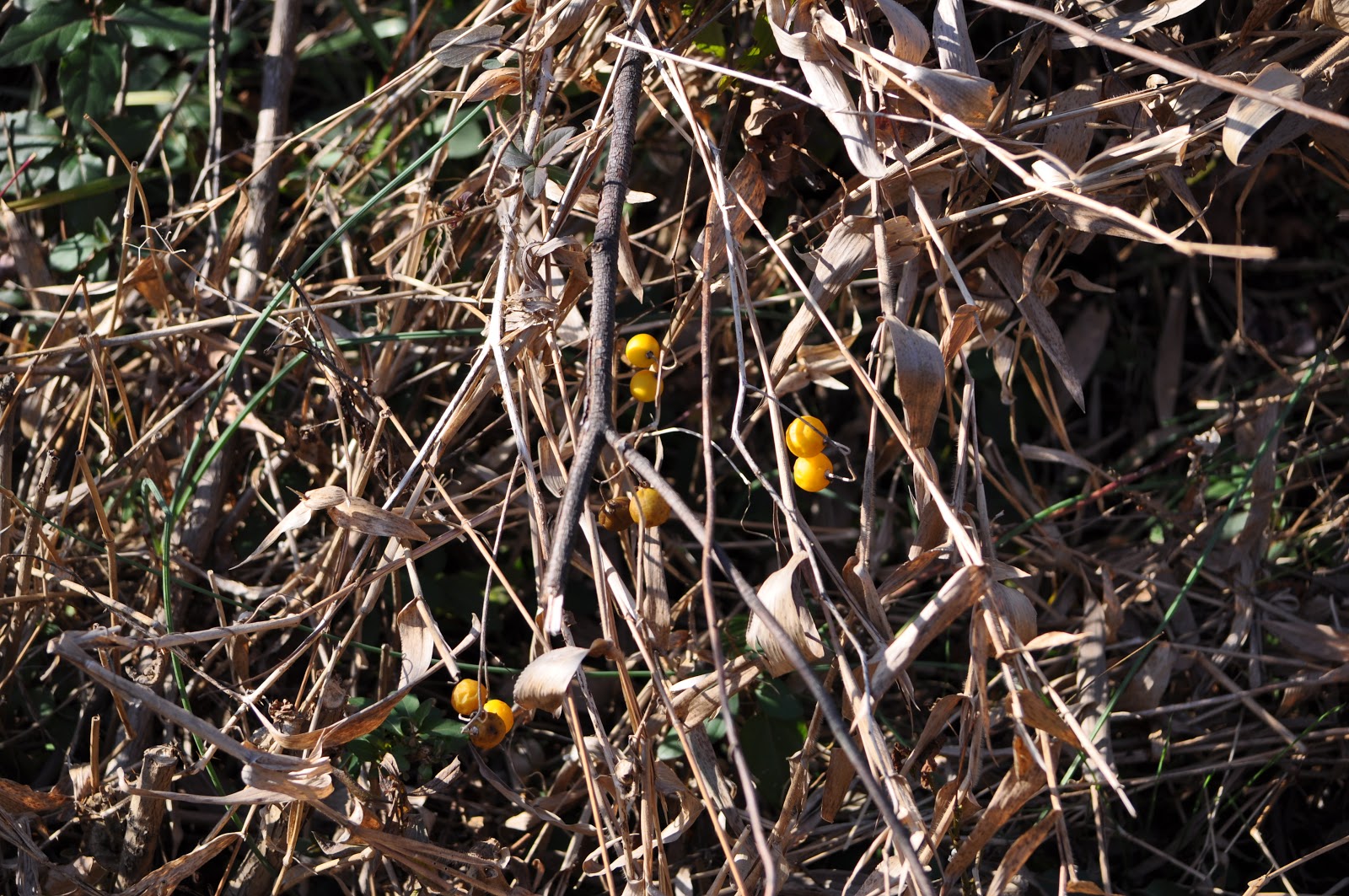
One more thing to look for in the winter woods is berries.  Many have already been eaten by the birds and critters, but look, you'll see a few. Along the bridge near the parking lot I found a new, for me, example of a winter berry.  They are yellow, about the size of a cherry tomato. But DON'T eat them.  They are the fruit of the horse nettle and are poisonous.

 This is enough for now.  Please don't let the 'drabness' of the winter woods keep you from enjoying their beauty. It is just a different type of beauty. Guided walks will resume in February when my foot is healed. Until then, enjoy the blog and enjoy the winter woods.
P.S....learn more about nature at the website for Virginia Master Naturalists.  Or visit us on Facebook on the Central Rappahannock Chapter of Virginia Master Naturalists site.
Thanks, Maria C., VA Master Naturalist

Friday, December 21, 2012

Purchasing the Island


In 1791, George Washington was asked by Congress to appoint three Commissioners to oversee the building of the nation’s new federal city and buildings.  After they were appointed, they, along with Washington, chose Pierre L’Enfant to explore the lands around the Potomac River to see if they could find stone suitable for the construction of the Capitol and President’s House.  They did not want to use stone from Europe, but rather use stone indigenous to the new United States of America. 

Pierre L’Enfant visited Brent’s Island in Stafford, I believe, at the encouragement of George Washington.  (George had used the stone from the island for his steps at Mount Vernon, as he was very familiar with the island since he grew up here.)  In December, 121 years ago, L’Enfant purchased the island for 1,800 pounds or $5,400.  He was purchasing it for the U.S. Government. 
                                           Jane C., historian


Tuesday, December 11, 2012

Winter birding at Government Island

As winter approaches, Government Island has started to look a bit bleak.  However, the bare trees and lack of ground covers and grasses makes it an ideal time to stroll the path enjoying clear views of the many birds that winter over in our area.  These past few weeks have given visitors ample opportunities for birding and photography.  Here are a few of the feathered beauties I spotted on 2 recent sojourns into the park.
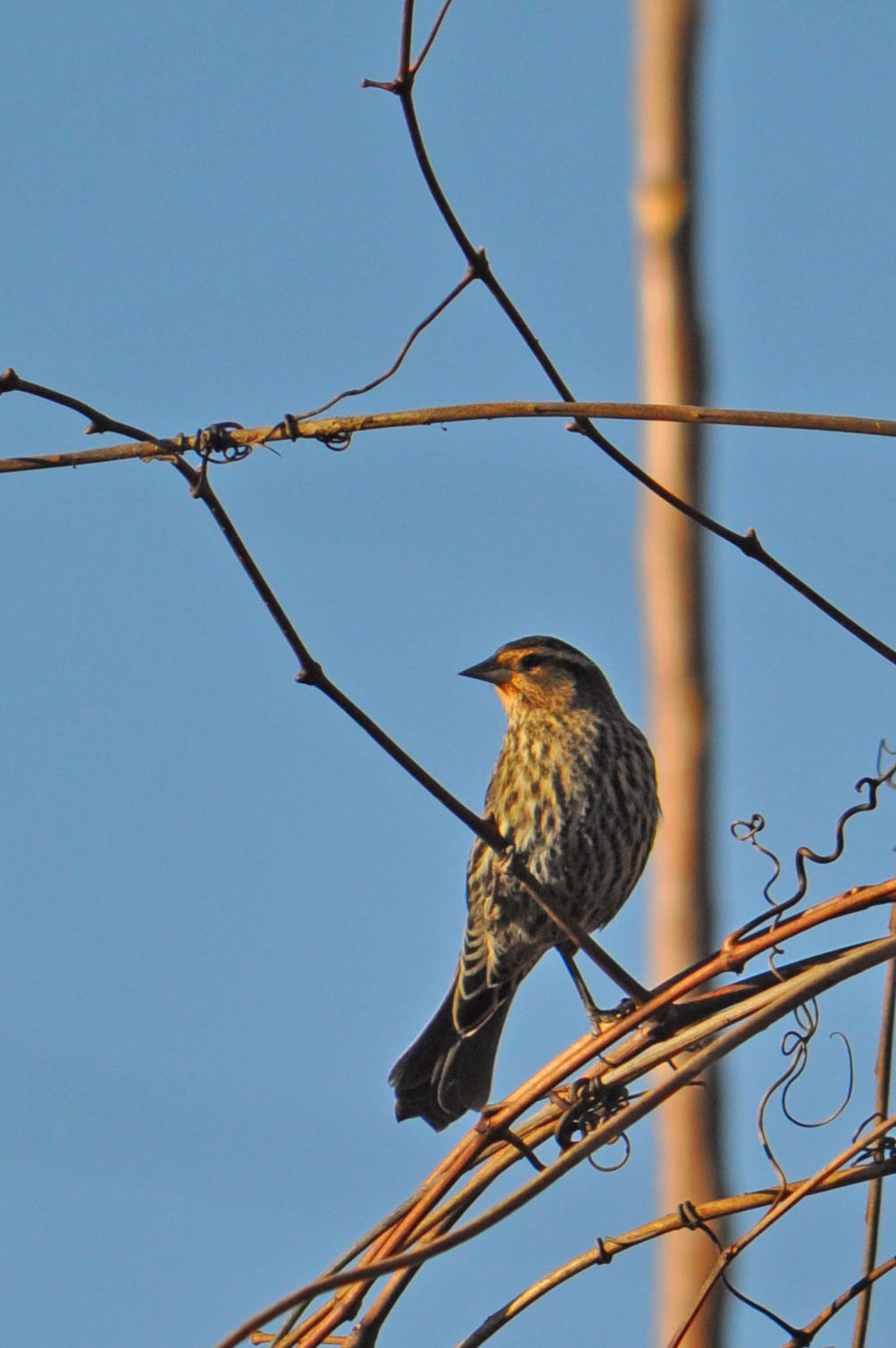
As always, take time to view the fields around the parking lot, and along Austin Run and the old beaver pond.  These areas are a haven for small birds due to the large amount of seeds that have been dropped by the died back vegetation.  Here you might find yellow-rumped warblers, sparrows of various types, and might see and hear the belted kingfishers as they rat-a-tat along the creek.  Not as stunning as the male red-winged blackbird, this female red-wing is still a handsome specimen.
And of course, there are always sparrows to watch for at this time of year.  Frequently, they can be seen hopping around in the leaf debris digging up something tasty to eat.  I find the white-throated sparrow to be an attractive little bird.

Wandering along the path at this time of year it is easier to see into the trees.  Listen for the calls of the many types of woodpeckers that frequent the area.  This yellow-bellied sapsucker was gathering lunch when I spied it in the trees between the path and Austin Run.

Not far from that sighting this wren popped up and posed for its photo.  I love the Carolina wrens.  They are quite sassy and almost friendly. I guess they are just naturally curious little darlings.
As I wandered closer to the beginning of the bridge where Austin Run makes its sharp right turn, I spotted a real treat.  At first I thought it was an ovenbird, but later it was ID'd to be a hermit thrush.  Well, I try for accuracy!
Although I hate poison ivy, and GI has more than enough of the nasty stuff, it does provide winter food for our feathered friends.  Here we have a junco helping himself to the white berries of the poison ivy plant.  Beware...the berries are just as reactive to humans as the rest of the plant.  The warbler in the earlier photo is also dining on poison ivy berries.
When you arrive out to the marsh overlook area, winter is especially a better time for birding.  The aquatic plants have all died back making the marsh surface a great feeding ground for birds.  At this time of year you will see killdeer busy eating away at scattered seeds.  The photo isn't one of my best, but I had the wrong lens with me and the lighting was not conducive to National Geographic quality photography!
Now that we have reached the marsh we will almost every time see a great blue heron out there somewhere.  This big male was busy preening those glorious feathers of his.
As I close this entry, I leave you with one more photo of some winter inhabitants, gulls.  I have to admit to laziness and haven't pulled out my Stokes or Sibley to ID which kind of gulls they are.  I'll let you do the work. But there are plenty of these guys out there, squawking and fussing as they pig out on the seeds from this past summer's aquatic plants.
Until next time, get out and enjoy Nature.  She is wondrous at any time of year.
Maria Cannata, Master Naturalist, Central Rappahannock Chapter, Virginia Master Naturalists

Tuesday, October 30, 2012


Aquia Stone in America

A couple of months ago, I mentioned another quarry, the George Washington Stone Corporation, which quarried Aquia Stone in the 1920s and 1930s.  Records show that stone from this Stafford quarry was shipped to aid in the completion of over 60 structures throughout America.  For example, it can be found in Harkness Hall at Yale University in Connecticut.
Its stone went to make the Pilgrim Steps at the National Cathedral in Washington, D.C.  It was even shipped as far west as Omaha, Nebraska, to help build the Joslyn Art Museum.
Today you can see it locally in the Fredericksburg Area Museum and Cultural Center at the corner of Princess Anne and William Street.  First built as Planters National Bank, Aquia Stone can be found in its decorative trim, quoins, and window surrounds.         Jane C.

Wednesday, October 3, 2012

Autumn in the woods; virgin's bower, beechdrops,strawberry bush, mile-a-minute vine, Japanese stilt grass, Chinese lepedeza, Lady's thumb

It is Autumn in the woods!  Government Island continues to charm us with its ever-changing flora.  The naturalist guided nature walk on Saturday, September 22 was another success.  The area along Austin Creek was somewhat devoid of animal activity, but there was plenty of non-native invasive species to view and discuss.  Government Island has a long history of human activity, therefor it is designated as a disturbed site.  Years of human interaction has introduced many types of non-native species.  These plants take over and crowd the native plants, much to their detriment.  Mile-a-minute vine is really creating a problem along the creek.


 Japanese stilt grass is competing heavily with Lady's thumb along the pathways.  Many feel that Lady's thumb is also an invasive species, but I feel it looks a lot better than the stilt grass.  The pink flower is the lady's thumb.  Unfortunately, the lepedeza has gone to seed guaranteeing plenty of new plants next spring.  Yuck!


But all was not disagreeable on the walk.  We were treated to a lovely show of  virgin's bower entering its seeding transition.  It is much showier at this stage, don't you think?


A real treat was finding a strawberry bush that was also going to seed!  I have never observed this plant at this stage and was initially confused as to what it was.  Most of the strawberry bushes I have seen were scratty little things, barely hanging on to existence.  Seeing this plant in all its red glory was a treat.


Another treat was finding a patch of beechdrops on the island.  This plant is a parasitic plant that grows under beech trees.  Looks like some kind if leafless sucker.


As we were crossing the bridge over the marsh, a wonderful bird siting.  A great white egret.  Not a common site at Government Island, but not one I haven't seen before.

The thistles are turning to seed.  I have noticed that there are fewer goldfinch in the field this year.  Last year they were all over the thistle collecting seed for their nestlings.  But a few butterflies still linger.

There will not be a walk in October, but we hope to see you in November on 17th.  Most likely at 8 AM.  Watch this site for the time announcement.  Or check in the Free-Lance Star Weekender section the Thursday before, Novemebr15. 
Great seeing you here!
Maria C. , Virginia Master Naturalist.


Saturday, August 18, 2012

August nature walk, emerald ash borer, tiger swallowtail butterflies, bull thistle, duck potato, spicebush, shelf fungi

Saturday, August 18, turned out to be a perfect day for the monthly nature walk at Government Island.  Naturalists Kristen and Maria took a group for a trip around the Island in near perfect summer weather.  First we stopped at an ash tree to learn about the emerald ash borer and view one of the "purple kite" monitoring stations that has been placed in an ash tree at Government Island.  These unwelcome insects have been found in Stafford and pose an environmental hazard to the ash trees in our county.  If you have ash trees on your property, you need to read about the emerald ash borer and report any infestation to the extension office at the Rowser Building.  They will direct your info to the correct people. 

Thistle is coming into bloom in the fields near the parking lot at this time of year.  It is a favorite of black swallowtail and tiger striped swallowtails.  At one point today I counted over 21 butterflies on this one plant.  As summer progresses, watch for the goldfinches coming to the thistle plant for fibers to line their nests and thistle seed to feed the chicks.  I have already noticed an increase of goldfinch activity in the area.  Later in the winter this area is a favorite place for a variety of species of sparrows.
Along the path that follows Austin Run look for the spice bushes, Lindera benzoin, displaying their bright red berries.  This plant is a member of the same family as the Sassafras family.  But don't wait long, or else the birds will eat the fruit.

As you get out towards the marsh, peak over the boardwalk railing, on the right,and look for the bloom of the duck potato plant, Sagittaria latifolia,  I have been waiting for this one to come into bloom, as I had never seen it before.  It was a real treat to see some beautiful specimens in bloom today.  They weren't there five days ago, and I am not sure how long they will be in bloom.  One more reason to frequently visit Government Island.

Today we noticed quite a few mushrooms sprouting up along the path.  As the forest gets moister, this trend should increase.  Remember...even the experts aren't always sure what is edible and what isn't.  Be safe and DO NOT EAT WILD MUSHROOMS.  We did spot a very pretty example of a shelf fungi.  This beauty is new to me and I have no idea which of the thousands of kinds of fungi it could be.  Most shelf fungi are not poisonous, they just aren't palatable.  Usually they are quit chewy, with some being almost wood-like.

Our next walk should be September 15.  We will watch the park and see what is happening, and pick the time of day depending on the weather patterns, either a morning or afternoon walk.  Hope to see you.

Maria C., Central Rappahannock Chapter, Virginia Master Naturalists


Thursday, August 9, 2012

Drought continues, praying mantid, thistle, Eastern tiger swallowtail

This week has seen no rain, again, at Government Island.  The vernal pool is not even mud anymore.  Just plain dry.  No wonder a true vernal pool does not have a viable fish population.  I am posting a photo of the pond near the parking lot.  The photo has changed a lot from last week's observation.  A few more dry days and there will no water connecting the upper portion of the pond to the lower portion.


However, even with the dry weather, there is always lots to see at Government Island.  On the milkweed in the field by the parking lot I found a lovely praying mantid.  Using my observation skills as I scanned the field I noticed something that just didn't profile correctly.  When you go out to enjoy nature, look for things that don't fit into what you should be observing.  Most likely it will be some interesting find.  The insect made the shape of the plant tops not curve correctly, and "tada!"  There was a wonderful sighting of a praying mantid.

I was excited to observe the first of this summer's thistles in bloom.  Apart from great photo opportunities when the Eastern tiger swallowtail butterflies land on them, thistle reminds me that goldfinch breeding time is approaching.  Goldfinches line their nests with the fibers of the thistle seed head.  Then they feed their young with the fresh thistle seed.  Watch for the birds getting busy as August leads into September and the goldfinches get really busy there in the fields by the parking lot. 

Hope to see some of you at the next nature walk on Saturday, August 18, at 4:00.  Meet in the parking lot.

Maria C., Naturalist, Central Rappahannock Chapter, Virginia Master Naturalists


Tuesday, August 7, 2012

It's Almost Time to Go Back to School

Now I know this is usually the last thing that you child would want to hear, but it is almost time to go back to school. However, this does not mean that there is no longer any time for fun. By taking a trip to visit Government Island, your child can have fun, and perhaps not even realizing that they are learning.

Government Island has a wealth of various animals and plants, making it an excellent place to demonstrate how the ecological cycle works, what a habitat is, and plant and animal life cycles. And that's only to name just a few topics that are often covered on in both the classroom material and the SOLs. The island is also a wonderful place to connect to topics in history, such as the birth of the nation, slavery, changes in technology over time, and Virginia history.

I'm hoping that eventually we will have various lesson plans and materials in subjects such as science and history for at least the K-5 levels, which we will make available on the blog so that parents and teachers can use it.

Come and visit Government Island before the school year begins (don't worry it will still be open after that) and help your child to learn and explore...without ever having to mention that you're preparing them for their classes!

If you want, come join Maria C. on Saturday, August 18 at 4:00 for a free guided nature hike.